Noise from Aircraft, when do you start and stop engines and soft touchdown?
Question
1: Where does the noise you hear when you board the aircraft come from? It sounds like a jet engine and I presume it is not the engines running?
2: When do you start the engines and how soon after touchdown do you switch them off?
3: When the aircraft lands, does the difference in soft landings come from experience and routine, or is it random?
Answer
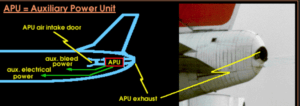
1: The “howling” you can hear while boarding, and sometimes deboarding an aircraft, comes from its auxiliary power unit or APU as we call it. It is a small jet engine, most commonly placed at the rear end of the aircraft, and it is rather noisy! Its function is to provide the aircraft with electricity and air for the air condition, and to start the engines when it is time. Sometimes smaller aircraft does not have such a device and the airports sometimes still use diesel driven generators to supply these with electricity, and the noise will be quite different from that of an APU.
2: At most airports it is not allowed to start the engines until the aircraft is ready to being taxiing for take-off, and this is either done after the aircraft gets pushed out from the gate, or if its parked in a position where it can start taxi with no push-back, at the remote gate. These restrictions are based on the fact, that modern jet engines are so powerful that even running at idle, the blast can be quite damaging to people, material and buildings, so they get pushed away to remote positions where it is safe to start the engines.
After landing the aircraft, the engines are shut down when parked at the gate. On rare occasions the aircraft gets towed into the gate, the same way it left for take-off. Often depending on many circumstances and procedures, we can shut down one or two engines on the way in after landing, to save fuel, engine lifespan and reduce noise at the airport.
3: It is often a matter of good airmanship and skill, to make a reasonably soft landing in an aircraft. But there are some consequences to such a landing, as it will use up some of the runway, and all modern aircraft manufactures have made all the performance calculations based on what we call a firm touchdown. There are far too many aspects in explaining all the factors involved in this, but rest assure that when we make a soft touchdown, we have considered the performance and weather conditions. A rule of thump in this would be that long runways where we have no limiting landing distance available, we use a bit of skill and try to set the wheels nice and smooth. When the weather is poor, and the runway is slippery, we make sure to land more firmly as we can predict exactly where the wheels touch down, and many of the systems on an aircraft are dependent on knowing when it is safe to start braking and using for instance “spoilers” which help reduce airflow over the wings. In any case, we always take safety first, so we would never intentionally “drop” the aircraft on the ground 
Best regards, Ask a Pilot!