

Save money! How you can stay sharp within spending money on flying
Here are some money-saving tips – if you don’t have money to go flying and you need to stay sharp
You can stay sharp when you cannot fly for the price of 5 minutes in the simulator. This is good knowledge for both training departments and pilots. Learn how here.
Mental training and advanced visualization are the answer
This answer comes from Freddy Gleisner. Freddy is committed to sports and performance psychology and he has worked in this field for 31 years. He has worked among others for Olympians, different sports teams, individual professional athletes as well as private companies.
We interviewed Freddy about his tips for pilots.
How can you convince me that it can help me as a pilot?
I have coached and trained many different types of people and helped them master mental training. For example, some of the world’s top athletes, musicians in big symphony orchestras, top CEOs who had to make big decisions, and students who had important exams. Lately, I have also helped pilots who were faced with pressure. The pressure could be getting a job or going through a step like command training. By complementing their other type of training with regular mental training, they have achieved the results and goals, that their efforts justified them to get, and in many cases, they exceeded themselves and fulfilled their dreams.
An example of the power and effectiveness of mental training
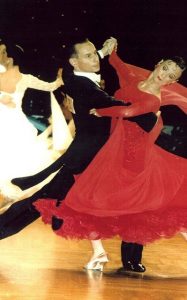
Camilla and René
Throughout a long period of time I had worked with a ballroom dancing couple; Camilla Egstrand & René Christensen, leading up to the Ballroom World Championship. Here they were going to prove that they belonged in the top ten. 3,5 months before the World Championship I received a call from Camilla. She is crying on the phone, as she tells me she has suffered a severe injury in her leg, going to restrict her from training for a long time. This was a catastrophe as the World Championship was approaching and if Camilla and René did not compete they would lose their sponsorship support from Team Denmark.
I met with the unlucky dancer. Luckily she was already working with mental training. She was for example already using the advanced visualization, 20 minutes 1 to 2 times per week. Now the couple had plenty of time for more mental training. Normally the couple would train up to 3 hours per day, so now both the male and female dancer started visualizing the perfect dance for 30- 60 minutes every day using advanced visualization.
After 3 months, so only 14 days before the World Championship, they were united back in the training studio ready to take the first dancing steps. Here they got a big happy surprise. The technical level that they had held, 3 months previous, was intact. The mental training kept the technique current. They could naturally not train for as long as 3 months prior, as their physical strength needed to be trained up again. However, the happiness and motivation levels were huge, and the remaining 14 days before the World Championship was full of high-quality training. The result was that Camilla & René achieved a place as no 8 out of 70 of the world’s best couples. Following that result, I did not need to remind them anymore about the importance of mental training.
Why is it important to start with mental training right now?
Mental training is not a quick fix. You cannot train a few times, and then with a magic move, you have become mentally strong. As with other skills, it takes time and requires training before you really get results. You may have the time now. That is why you should start now, so you can benefit from your work, next time you are back as a pilot on the flight deck.
It sounds a bit like chair flying, something many pilots already know?
The pilots I have met who knew about chair flying had not been given much training in it. It is a bit like having access to the GYM but no one has shown you how the machines work. I find it important that you learn, for example, how and what to visualize, to think positive, to block out negativity and distractions.
The type of advanced visualization I train is perhaps an advanced form of chair flying.
Advanced visualization
It is not only about the ”visuals”. You also have to imagine ”hearing” the commands on the flight deck. It is also about being able to imagine how touching and operating the switches and handles “feel”. Adding these extra senses to the visuals is why it is called advanced visualization. With the techniques, I can teach you are able to use advanced visualization to imagine how you work well with the technology. This could be the instruments, handles, or switches on the flight deck. Adding environments like other planes, ATC commands, the weather will make it even more realistic. If you train like this, then you can maintain your skills just as well as completing a real flight!
“Through mental training, it is actually possible to maintain your technical skillset as a pilot, even though you are not flying in a plane or a simulator. Many studies around the world have proved that by advanced visualisation exercises, it is possible to stimulate the brain in the same way as if the manoeuvre had been performed in reality.” -FREDDY GLEISNER
Apart from staying sharp, how can mental training help a pilot?
Apart from the extended visualization, I think pilots can benefit from getting into positive thinking. Learn to reject negativity. Learning to relax. Become better at concentration. Knowing how to handle pressure and nervousness.
“Mental training and learning how to for example handle pressure is, in my view, just as important as learning about how to fly a plane.“- FREDDY GLEISNER
As pilots, you go through a lot of tests all the time and you have a job where there can be a lot of pressure. I am surprised that pilots, in my experience, have very little or no introduction to mental training.
Where should I start, if I want to get into mental training?
If you are new to mental training a good place to start is to work with positive thinking. When this becomes a routine you become a positive person. You probably think that it is nice to be among positive people. Become one of them.
Another skill that is good to start training is the “thought-stopping technique”. This does not mean you train to stop thinking. Though stopping, is a mental skill where you learn to reject a negative thought. For example, if you start to doubt yourself and your abilities to solve situations that arise.
Once you have become familiar with positive thinking and thought-stopping, you can start moving on to advanced visualization.
How often do I need to train?
Working with positive thinking never stops. People are different and learn at different paces so hard to say how long you need to train the basics before you are ready for anything advanced. Once you are ready for the advanced visualization, I suggest you train 3- 4 times per week for 30 minutes each time.
Where can I get help if I need a little guidance or help to get going?
I have developed a training package for pilots who want to get into mental training. It consists of a booklet and audio files. To help pilots with advanced visualizations I have created an audio-guided exercise I call an inner movie of a flight. During this exercise, I talk you through a flight. Not how to fly, but I help you to get into a state of relaxation. I then control the speed of the movie. You can make variations in the inner movie. You may take off or land at different airfields. Fly various types of approaches. Fly in various types of weather. Or handle various complex non-normal all of which you will handle perfectly.
What kind of pilot is this suitable for?
It does not matter if you are a student pilot, a new pilot, or an experienced pilot. You make the inner movie relevant to your situation. At the moment the aim could be to use advanced visualization to stay sharp, so you are ready to get safely back in the air.
The material is designed so you can get going on your own, but if you need help – one on one coaching with me or one of my colleagues could be arranged via Ask A Pilot.
Happy landings


