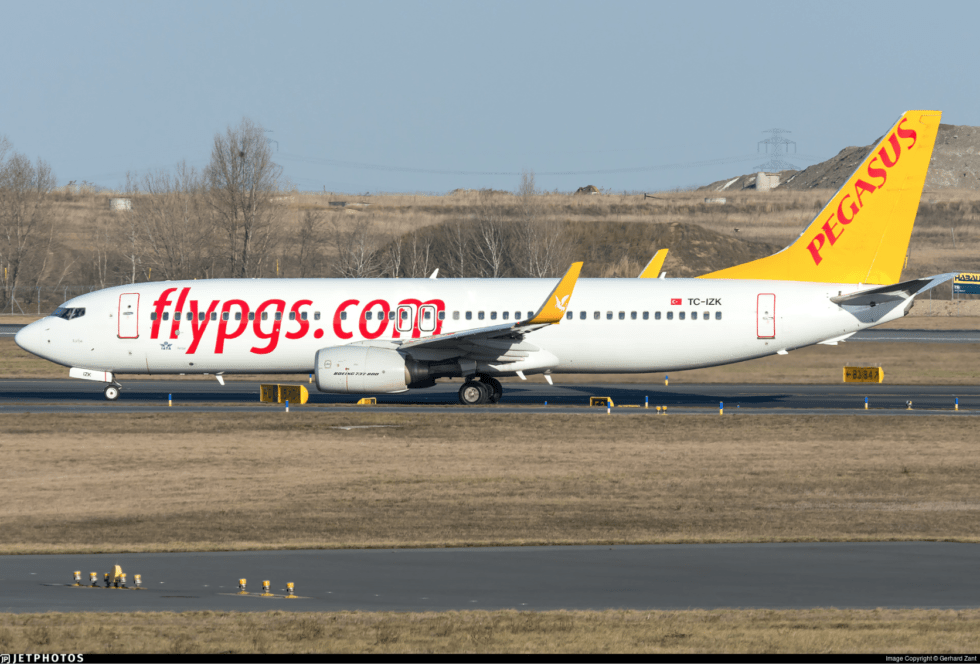
Why was the Pegasus PC2193 crash strange?
We would like to start expressing our deepest sympathy towards the families, passengers, crew, and Pegasus Airlines regarding the accident involving Flight PC2193.
According to ICAO (International Civil Aviation Organization) Annex 13 “Aircraft Accidents and Incidents Investigation”, it is now the Turkish Aviation Authorities who are in charge of the investigation. Until this investigation has been completed, it remains difficult to determine the reasons leading to the accident.
Our intention with this blog is to analyze the data which is freely available through Flight Radar. We suggest you have this data available to you as you read through our comments and analysis.
Below is the weather report from the time around the accident
LTFJ 051520Z 29022G37KT 240V330 7000 -TSRA FEW017CB BKN025 BKN070 11/09 Q0992 RESHRA NOSIG
This format will most likely not make any sense for non-aviation personnel, so let’s translate this:
The weather report is from the 05th of February 2020 time 1520 Zulu (UTC). Wind direction 290 degrees 22 knots gusting up to 37 knots, variable from 240 degrees to 320 degrees. Visibility 7000 meters with light thunderstorms and rain. Few clouds in 1700 ft and broken clouds at 2500 and 7000 feet. Temperature +11, dewpoint +9 and pressure altimeter setting 992 hectopascals. There have been recent showers of rain and no significant change to the weather within 2 hours.
Let’s analyze the weather
Generally, planes will be landing against the wind as this gives a slower ground speed which shortens the landing roll. This is the same principle as in your car – it gives a shorter braking distance to be breaking from 50 miles per hour compared to 70 miles per hour.
With a runway direction of 059 degrees and a wind of 290 degrees and 22 knots, the plane has not been landing with a headwind but with a tailwind.
https://e6bx.com/wind-components/
If the plane has landed on runway 06 with the reported mean-wind of 290 degrees 22 knots, it would have had a crosswind of 17 knots and a tailwind of 14 knots.
With gusts up to 37 knots and direction 290 degrees (290/37), the plane would have had a crosswind of 28 knots and a tailwind of 23 knots.
The worst-case scenario (from a pilot point of view) is wind from 240 degrees and 37 knots as this results in a tailwind of 37 knots.
Why is this interesting? Well, it is since planes rarely land in strong tailwinds and that most plane manufacturers have a maximum allowed tailwind for the landing of 15 knots.
Technically the approach has been legal as the mean-wind is within limits (290/22) of 15 knots.
From a pilot point of view, it seems bizarre that the opposite runway (24) has not been in use instead.
Had runway 24 been in use, the mean wind of 290/22 would have resulted in a crosswind of 14 knots and a headwind of 16 knots.
The rest of the weather report does not look unusual. Visibility of 7000 meters and fair cloud ceiling, temperature, and pressure would place the weather conditions as fair. A wet runway as a result of the recent showers of rain, wouldn’t have significantly complicated the approach or landing roll.
Then let’s look at the approach
The approach to runway 06 has most likely been a 3,5-degree ILS (Instrument Landing System).
Runway 06 is 3000 meters long and 45 meters wide.
A normal approach angle is 3,0 degrees. Think about the angle as a steep hill. A steep hill is not a problem, provided you have some way of breaking. One method is to lower our landing gear and set flaps. This naturally results in aerodynamic drag, which helps to slow the plane down. With the landing gear out and flaps in an intermediate position, a 3,5-degree approach is not an issue.
A runway length of 3000 meters is more than adequate for a B737 plane. A width of 45 meters is standard.
Flight radar data
The speed that pilots focus on during the approach is the” indicated airspeed”. In simple terms: the speed that the plane travels through air and pilots observes from the instruments.
To keep it simple. If the mass of air moves with the plane – the wind is called a tailwind. If the mass of air moves against the plane – the wind is called a headwind. This matters when we talk about ground speed – the speed the plane moves over the ground.
Indicated airspeed of 140 knots and tailwind of 20 knots results in a ground speed of 160 knots.
Indicated airspeed of 140 knots and headwind of 20 knots results in a ground speed of 120 knots.
The speed that flight radar is giving us is ground speed.
Why flight PC 2193 on 05 FEB 2020 received what we call” delay vectors” has not yet been made public.
It could be due to Air Traffic Control instructions or it could be a pilot request.
What is interesting from a pilot point of view is the ground speed on the approach.
Normally a B737 will be configured with gear down and flaps either at ”30” or ”40” giving a groundspeed in the region of 130- 150 knots.
A deviation tolerance of plus 5 to 10 knots to the planned approach speed is normally acceptable.
If Flight PC2193 had technical problems involving for instance the flaps, it could have explained a higher indicated airspeed and as a result a higher ground speed. At the moment there has been no suggestion of any technical problems.
That leaves strong tailwinds or a faster than planned approach speed.
It is interesting to also look at the situation at 2000 ft.
Typically, a B737 following a 3,5-degree ILS will be configured at 2000 ft with gear and flaps at ”15”, this would result in a ground speed of about 180 knots.
Ground speed was 234 knots.
The data leaves us (as pilots) with 4 questions un-answered:
- The use of runway 06 with the reported wind
- Why did the pilots accept an approach to runway 06 with the reported wind?
- The high ground speed during the approach to runway 06?
- Why did the pilots not perform a go-around if the approach was not stable?
We hope that Pegasus Airline and the Turkish Aviation Authorities will share their investigation results with the rest of the industry, so we can all try to understand and learn from this devastating accident. At the moment what truly happened is speculations.
UPDATE
In March 2020 Turkish media reported on a preliminary report that was made by authorities. According to this report, the aircraft was struck by lightning about six minutes before landing. During the approach, one of the preceding aircraft before PC2193 reported a sudden tailwind of 37 knots below 600 feet. This information was communicated in Turkish by the ATC. The pilot monitoring was a Dutch first officer who didn’t understand Turkish. According to the report, subsequent clearances and weather information were in English.
The update does shed new light on the situation. Based on the new information the pilots have been in hurry to land the plane because of the lightning strike. The lightning strike would also shed some light on the pilots’ decision, not to go around. Also, ATC speaking in Turkish is an unfortunate event as the pilot monitoring was Dutch. Pilots were making a decision based on the information they had at the time and the Information was lacking or not the most up to date.
I am about to fly with Pegasus Airlines – what is your recommendation?
Well, it depends largely on how you feel.
If you look at factual information, Pegasus Airlines still hold approval to fly within European Airspace and that means that the Aviation Authorities considers them safe.
Traveling and go on holiday should be connected with joy. If you already now are experiencing dark thoughts and nervousness about your upcoming flight with Pegasus Airlines, it may be worth the money to re-book flight tickets.
As long as there are no further results about Flight PC2193, re-booking of flights is an expense you should expect to cover yourself.
Kind Regards,